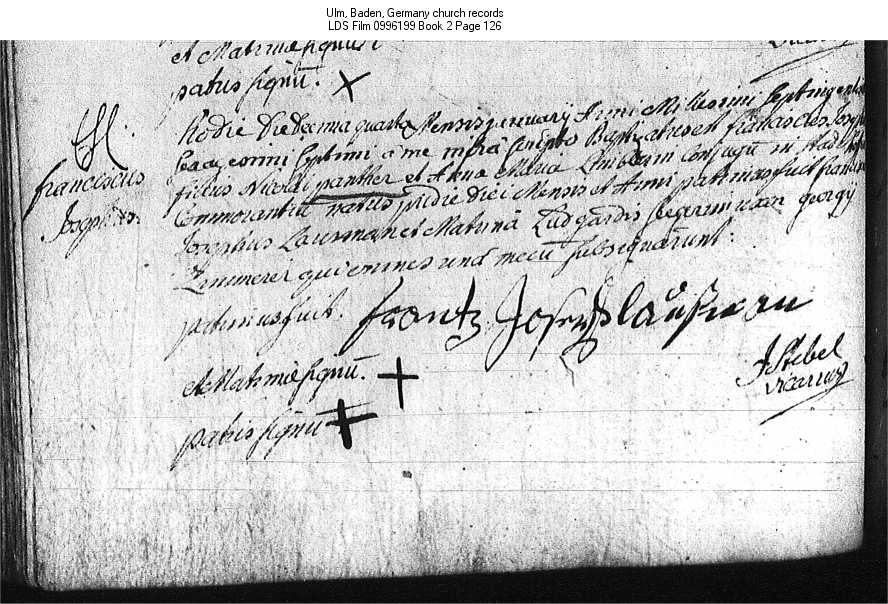
So, you've tracked your ancestors down to a small village in Europe and have obtained microfilm of the church books. A typical image will look similar to this:
Yes, it can be a challenge to read the handwriting and translate it from the original Latin. But still, they can be very legible and once you learn to translate the writing and Latin, you can make pretty quick work of the information.
Here's another page from the same marriage book:
This doesn't look too bad either until you need to get information from the entry that has the roman numerals bled through from the other side of the page:
This entry is for Martin Schnurr and Catharina Heiberger. They are a direct ancestor of Ludwig Doll and I'm trying to get this information together for his granddaughter. How do you extract their parents's names from this?
The first thing I'd try is to load it into a photo editor and attempt to adjust the brightness and contrast and see if you can see some detail in the roman numerals:
Unfortunately, as you can see, that doesn't help in this case. All you can do is rely on what you can see between the letters and use your experience and examples of writing from other pages to help figure out what is written there.
So we go back to the full marriage book entry:
What I can see is, just above the roman numerals "CD" appears to be Christian Schnurr, followed by filius et pudica. Filius translates to "legitimate son" and pudica translates to "pure" or "chaste", this is followed by the bride's name on the next line, which I already know is "Catherine". I also see just a few letters of her maiden name. The writing between the roman numerals matches up with what I expect to see. So, we see "Martin Schnurr"..."Christian Schnurr"..."legitimate son and the chaste Catharina Heiberger"...
Now we're speculating because we don't have any previous information about her father's name other than his last name. We have to rely on what we see between the Roman numerals X and I. The length of the name and first names I've seen in this village, along with the small amount of writing I can see between the letters makes me believe his name is written as
Hanss.
-- Edit - Looking at the earlier baptismal records, I now believe her father's name is Martin. It's not much longer than Hanss and does fit into the space. There's really very little to go on between the Roman numerals. I do see a Hans Heiberger fathering many children during this time period with his wife Catharina but I do not see a daughter of his named Catharina. I do, however, see a Catharina born to a Martin Heiberger and his wife Maria. I found where the name Martin was written by this same hand just a few pages earlier in this book. I extracted this written name and pasted it into the space on this page and it does fit and match up pretty well with what can be seen on the original page.


Now, this is not certain and I will definitely put notes in his database entry explaining my logic, just in case someone has access to the books themselves and can see more detail. Also, further research may lead to their birth records that hopefully will show their parents' names more legibly. --
Edit - It did. I found a Catharina born to Martin Heiberger.
In two bits of other news, first, my brother is recovering quickly from his fall. He has gone from the point where we thought we were going to lose him to the point where, a little more than a month later, he's going home! Thank you for all the prayers and good thoughts. They were needed and will be needed in the future as he still has a ways to go on his recovery, but it's looking very good!
Second, the next two rolls of microfilm of death records for New York have arrived at my local Family History Center. I hope to get there tonight to see if I can confirm my Dunzinger connection! --
Edit -- I didn't find the Dunzinger information I hoped to find. Time to order three more films and hope for better luck next time.
--Matt